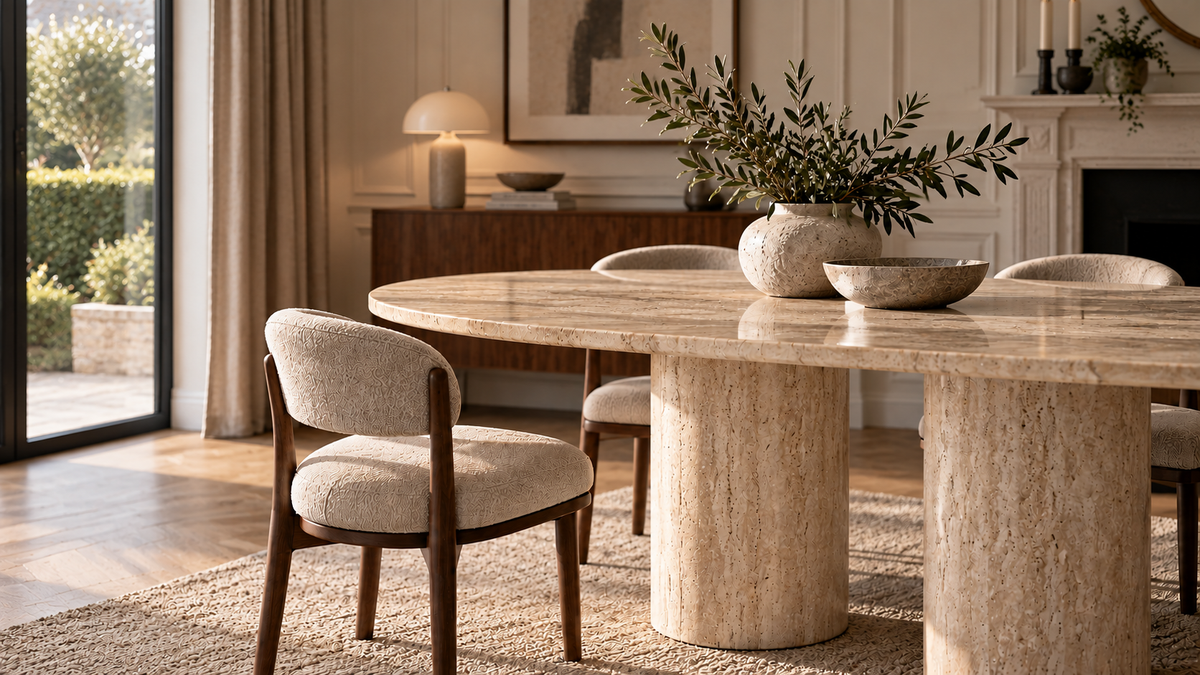
A natural stone dining table will not look exactly like another table made from the same named material. Its colour, veins, bands and surface markings are determined by the section of stone from which it is cut. No two sections are identical, and no two finished tables will be either.
This guide explains why natural stone varies, what kinds of variation to expect and how to approach the selection process when ordering a stone dining table.
Why Natural Stone Varies
Natural stone is formed over millions of years by geological processes. The mineral content, temperature, pressure, water flow and conditions present during formation all affect the stone's appearance. These conditions vary across a quarry, between quarries and between different geological periods.
When a block of stone is extracted and cut into slabs, each slab reflects the specific conditions present in that section of stone. The result is that every slab has its own pattern of veins, bands, markings and colour shifts.
This is not a manufacturing inconsistency. It is a direct consequence of how the material forms. Natural stone cannot be reproduced with the consistency of a manufactured surface, and it is not designed to be.
How Travertine Varies
Travertine forms from mineral deposits that build up in layers over time. This layering creates the banding pattern most associated with travertine, but the spacing, width, colour and direction of these bands differs from slab to slab.
Within a single tabletop, the bands may run consistently, shift in direction or change in intensity. Some areas may be lighter or darker than others. Small pits and cavities are part of travertine's structure, and their distribution across the surface is not uniform.
Travertine is also available in different colours, including Beige, Grey and Red. Each colour category contains its own range of natural variation. A Beige Travertine slab may contain tones from cream to deeper brown. A Grey Travertine slab may range from pale silver to stronger charcoal. The named colour is a guide, not a precise specification.
How Marble Varies
Marble forms when limestone undergoes changes through heat and pressure. The veining in marble is created by minerals present in the stone during this process. The colour, thickness, direction and density of veining differs between slabs.
Some marble has fine, delicate veins spread evenly across the surface. Other marble has bold, directional veins that create a strong visual movement. Some stones have a relatively even background colour; others contain significant shifts in tone across the slab.
Two tables described as the same marble variety may look noticeably different. The named variety describes the stone's origin and general character, but the actual appearance is determined by the individual slab.
What to Expect When Ordering a Stone Table
When you order a natural stone dining table, you are ordering a table made from a specific slab or set of slabs. The table will share the general character of the stone variety selected, but it will not match any photograph, sample or previously made table exactly.
This applies across all aspects of the stone's appearance.
Colour
The colour of a natural stone tabletop may be lighter or darker than a reference image. Within a single tabletop, colour may shift from one area to another. This is part of the stone's natural structure and is not a defect.
Veining and Banding
The markings on the finished table will follow the pattern of the specific slab used. Veins may be finer, broader, more or less prominent, or differently positioned than in a sample or reference image.
Surface Texture
Travertine's surface texture includes natural pits and cavities. How these are distributed across the tabletop is determined by the stone itself. Some areas may have more surface variation than others.
Tone Shifts
Areas of lighter and darker tone can appear within the same tabletop. These shifts follow the mineral patterns in the stone and are not the result of inconsistent finishing.
Working with Natural Variation
Natural variation is not a flaw to be managed. It is what distinguishes a stone table from a manufactured surface.
When selecting a natural stone table, the most useful approach is to consider the general character of the stone rather than expecting a precise match to a specific image. Think about the overall colour range, the typical pattern and how these will relate to the other materials in the room.
If you have strong preferences for quieter markings, bold veining, a particular colour balance or minimal surface texture, discuss these preferences before production begins. Natural stone cannot be duplicated exactly, but understanding your preferences can help guide the selection of an appropriate slab.
Samples and Reference Images
Stone samples and product photographs are useful references but should be understood as representations of the material's general character rather than a precise preview of the finished table.
A sample shows a small section of one slab. The tabletop will be made from a larger section of the same or a closely related slab, and it will show more of the stone's full range of variation.
Reference photographs may show a previously made table. The slab used for that table cannot be reproduced, and a new table will look similar in character but not identical.
Why This Matters When Choosing a Table
Understanding natural variation helps you approach the selection process with realistic expectations. A table that arrives with more prominent veining than the reference photograph, or with a slightly different colour balance, is not a defective table. It is a table made from natural stone.
The variation is also what gives natural stone its long-term appeal. A manufactured surface looks the same as it did the day it was installed. A natural stone table carries the specific geology of a particular slab, and no other table will share that exact appearance.
At Kavestone, all tables are made to order from natural stone. Each finished table reflects the specific material used in its production.


