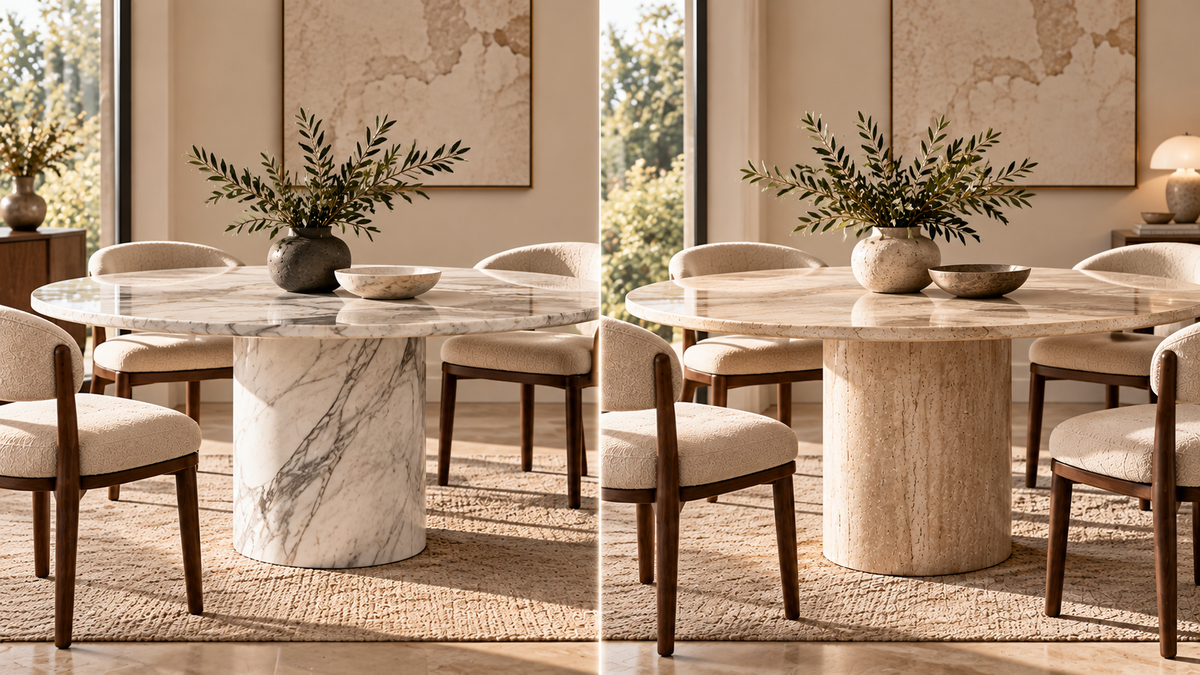
Choosing between a marble and travertine dining table is not simply a choice between two colours. The materials have different markings, textures and visual weight. They also respond differently to finishing and everyday use.
This guide compares marble and travertine by appearance, durability, maintenance, finish and cost, so you can decide which natural stone suits your home.
How Marble and Travertine Are Formed
Marble is a metamorphic rock. It begins as limestone and changes when exposed to intense heat and pressure over a long period. This process recrystallises the stone and creates the veining associated with marble.
Travertine is a sedimentary stone. It forms when minerals dissolved in natural spring water are deposited over time. The layering process creates the banding, small cavities and colour variation associated with travertine.
Both materials are natural stone, but their geological origins produce different structures, markings and surface characteristics.
Appearance: Marble vs Travertine
Marble is characterised by strong veining that runs through the stone. The veins can be fine or bold, and their colour depends on the mineral content present during formation. Common marble colours include white with grey veining, white with gold veining, and darker stones with contrasting lines.
Travertine has a banded appearance rather than distinct veins. Its markings tend to be softer and more horizontal. Small pits and cavities are part of travertine's natural structure, and these can be left open or filled during preparation.
Both stones contain natural variation. No two slabs will be identical, and the finished table will not match a small sample exactly.
Surface Texture and Finish
Both marble and travertine can be polished to a reflective finish or left with a more matte, unpolished surface.
Polished marble has a glassy appearance and usually displays its veining strongly. Polished travertine shows its banding clearly but tends to have a slightly different sheen to marble due to differences in the stone's density.
Unpolished versions of both stones have a softer appearance and show less reflection. An unpolished finish can make travertine's texture more visible, particularly where the stone has been left unfilled.
Durability: Marble vs Travertine
Both marble and travertine are hard natural stones that can be used for dining tables, but neither is indestructible.
Marble can be scratched by sharp objects and etched by acidic substances. Wine, citrus juice, vinegar and some sauces can dull or mark an unprotected marble surface.
Travertine is also hard but has a porous structure. It can absorb liquids if unprotected, and acidic substances affect it in a similar way to marble. The cavities natural to travertine require the surface to be correctly prepared during manufacturing to ensure an even and functional finish.
Both materials perform well when correctly maintained. The difference in durability between the two is less significant than the difference between a well-maintained stone and a neglected one.
Maintenance: Marble vs Travertine
The care requirements for marble and travertine are broadly similar. Both benefit from prompt removal of spills, the use of coasters beneath drinks and place mats beneath hot dishes, and cleaning with products confirmed as safe for natural stone.
Acidic cleaners, bleach and abrasive materials should be avoided with both stones. These can etch the surface or remove its protective treatment.
Marble's veining can make marks and stains more visible in some areas than others. Travertine's banding can have a similar effect, but the nature of the pattern means marks may be less immediately apparent.
Check whether the table you are considering has received a protective treatment and whether periodic resealing is recommended. This applies to both materials.
Colour and Interior Fit
The colour range available in marble is broad. Common options include white, cream, grey, beige, green, black and various combinations of these tones. The veining adds a further variable to how the material reads in a room.
Travertine's palette tends toward warmer, earthier tones. Kavestone offers Beige, Grey and Red Travertine, each with its own natural banding and variation.
The right choice depends on the room rather than any absolute quality of the stone. A white marble table can complement a clean, minimal interior. A beige or red travertine table tends to work well in warmer, more textured schemes.
Cost: Marble vs Travertine
Both marble and travertine are premium natural stone materials. The cost of a finished dining table will depend on the size, the specific stone selected, the edge profile, the base and whether the table is made to order.
Certain marble varieties, particularly rare or large-format stones, tend to command higher prices than comparable travertine. However, both materials sit in the premium segment of the dining table market, and the difference in cost between the two is not always significant once other variables are included.
Which Should You Choose?
Choose marble if you prefer bold, directional veining, want a wider range of colours and tones, or are designing a room around a strong visual centrepiece.
Choose travertine if you prefer softer, more horizontal banding, want an earthy or warm colour palette, or are drawn to the textural quality that comes from the stone's natural formation.
Both materials require appropriate care. Neither is maintenance-free, and both will perform well in a dining setting when correctly prepared and looked after.
At Kavestone, tables can be made to order in your choice of travertine or marble, with options for size, shape, finish, edge and base.


