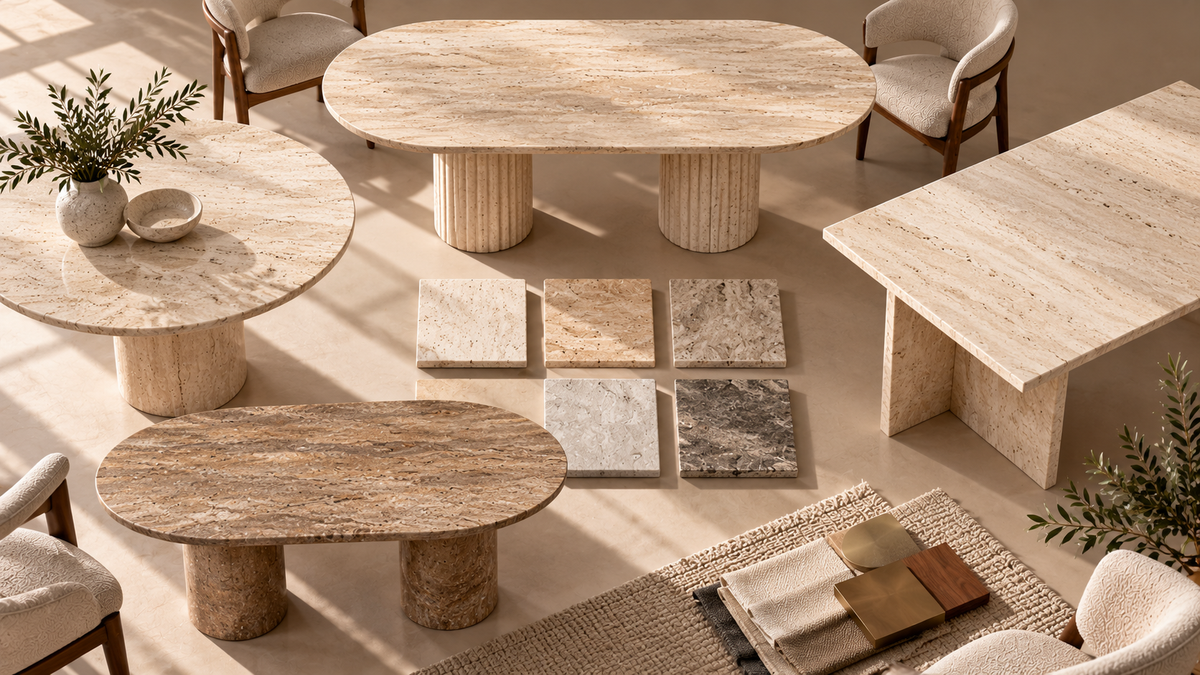
A travertine dining table is made from stone that has developed naturally over time. Each slab has its own colour changes, lines, cavities and mineral markings. These features make every finished table different.
Travertine is also a material that needs to be chosen with care. The right table must suit the size of the room, provide enough seating and allow people to move around it comfortably. Its shape, stone colour, surface finish, edge and base should work together rather than being selected separately.
This guide explains what to consider before buying a travertine dining table, including its practical qualities, available colours, suitable dimensions and everyday care.
What Is Travertine?
Travertine is a type of limestone formed by mineral deposits from natural springs. The way these deposits build up creates the bands, small cavities and changes in colour associated with the stone.
Its appearance depends on where it was quarried and how the block was cut. One slab may have long horizontal lines, while another may show cloud-like markings or stronger changes in tone.
Some travertine surfaces retain visible cavities. Others are filled and finished to create a smoother surface. Neither appearance is artificial or incorrect. They are different ways of preparing the same natural material.
Travertine is not marble, although the two materials are sometimes grouped together as natural stone. They are formed differently and have their own appearance, texture and care requirements.
Is Travertine Suitable for a Dining Table?
Travertine can be used for a dining table, provided the stone is correctly supported, finished and cared for. It is a hard natural material, but it is also porous. Unprotected travertine can absorb liquids, and acidic substances may affect its surface.
Is a Travertine Dining Table Durable?
Travertine has been used in buildings, flooring and furniture for many years. When it is properly prepared and supported, it can provide a strong dining surface for regular use. However, durability does not mean that the stone cannot be marked. Travertine can be stained, scratched, chipped or etched if it is exposed to unsuitable products or careless handling.
Choosing a Travertine Colour
Stone colour affects more than the appearance of the tabletop. Kavestone offers Beige, Grey and Red Travertine. Each stone has its own natural variation, so samples and photographs should be treated as a guide rather than an exact preview of the finished table.
Beige Travertine Dining Tables
Beige Travertine usually contains cream, sand and light brown tones. It works well with pale woods, oak, cream upholstery and warm neutral walls.
Grey Travertine Dining Tables
Grey Travertine can include silver, charcoal, pale grey and warm grey bands. It works well with black details, darker woods, metal finishes and cooler wall colours.
Red Travertine Dining Tables
Red Travertine contains shades of rust, clay, terracotta, burgundy and brown. It is a stronger design choice and is likely to become the main colour feature in the room.
Choosing the Right Table Shape
The shape of a stone dining table affects seating, movement and the amount of visual space it occupies. Kavestone offers rectangular, oval, round, square and ellipse dining tables.
How to Choose the Correct Dining Table Size
Measure the available dining area before deciding how many people the table should seat. Allow around 90 cm between the edge of the table and a wall or nearby furniture. Kavestone's oval, rectangular and ellipse dining tables are available in lengths from 140 cm to 280 cm. Round and square tables are available from 100 cm to 160 cm.
Surface Finish: Polished or Unpolished?
A polished surface has more sheen and usually makes the colour and markings appear stronger. An unpolished surface has less shine and a softer, more natural appearance.
How to Care for a Travertine Dining Table
Remove spills promptly. Use coasters beneath drinks and place mats beneath hot dishes. Clean with a soft cloth and a cleaner confirmed as suitable for natural stone. Avoid acidic, abrasive or bleach-based cleaning products.
Why Choose a Made-to-Order Travertine Table?
At Kavestone, you can select the table shape, dimensions, travertine colour, finish, edge profile and base. This allows the table to be planned around the room instead of choosing the nearest available standard size. Explore Kavestone's travertine dining tables or use the table configurator to create a made-to-order design for your space.


